N O W A
V A I L A B L E :
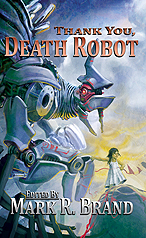
THANK
YOU, DEATH ROBOT
edited by Mark R. Brand
Publisher: Silverthought Press
ISBN: 978-0-9815191-9-7
270 pages
paperback: $14.99
+ S/H
[click
for details]
The music has fallen silent above me,
leaving all that precious little left beneath the shell a
hollow echo of everything we could have been, now struck beyond
extinct with the brutal grace of the deception.
I breathe out to ten beats staggered
through my throat.
The boy is choking below me.
What's left of him isn't much. I survey
the wound but there's more wound to him now than not. How
he's singing with such a concave head and half of him garroted
off, it's more than a little disconcerting. My hands can't
cradle that tenderly enough through the copper torrent. I
lay his head to rest and wipe what I can to clear his mouth.
"I have no doubt," he says,
"we'll reach to strike the stars from the sky."
Something in that cores me. I don't
know if it's a direct translation. The growing dead in his
eyes is a slow approximation of others I've seen.
My claws retreat to the guts of the
thing. Calliope writhes.
"We'll know the dead lines in
their collapse."
My fingertips stumble over three studded
papules. Three. Six, seven, nine. Fourteen.
"The song will find you."
That stops me.
I tear the mask from my face and breathe
deeply.
By the time I realize she's stopped
talking, Clare is dead.
Bill is singing something I don't recognize,
something brisk and atonal as the duck shudders on the line.
Cal's staccato responses ring through the pit and the undertones
churn something black and restless in my stomach. I don't
need to speak their language to understand that something
is wrong; the speed of sound paints their panic thickly through
the chamber.
I'd turned away from the panel in anger,
and now I rock back to see the image of my wife slumping in
her seat, face slack, all tension removed from what had been
an unpleasant exchange. Gravity drags. Her chin comes to rest
on her chest, furrowing the flesh a way her affected vanity
would hate. Her head pivots gently to the left, a thin line
of wetness spilling from her open mouth, the slack tongue
lolling silent nonsenses. Her eyes are a kind of empty that
constructs a foundation of new horror within me. Matte. Then
blood. On edge for the duration of our quarrel, she now tilts
out of the seat, leaving the panel to display nothing but
the chair and the wall, the seat spinning exactly one orbit
and back into place, the wall catching only its shadow and
then resuming its function as staid backdrop. I watch Clare's
eyes as she falls, like that locked gaze can hold her in place
and buffer her from striking the cold limit of the floor.
The sound Cal is making, it isn't music.
"Clare?" I say into the link,
knowing nothing more appropriate, hoping she'll climb back
up into the chair, wishing my last words to her had been something
a little more not what they were, quickly realizing that the
great falling feeling in my chest isn't going away and is
in fact taking hold with a branding edge I already suspect
will last the duration of this lost life.
The usual chiming resonance of the
embassy has been replaced with silence—no, there is something.
The sound of impacts. Things hitting the floor. Bouncing,
rolling, some of them. Most sounding like what I hope aren't
bodies, the meat slap of flesh on steel.
And still all I can see is a chair,
a wall. No Clare.
Scrambling footsteps near me—Billy
jogging from panel to panel, Cal chuffing along behind him,
the hum and whistle of his jets barely audible beneath the
frightening stream of notes.
"Billy?" I say, calling up
the diagnostics. "Something's wrong with the line. I
think Clare—"
"Nothing's wrong with the line."
He runs to my side, waves away a test window. "All the
connections, the embassies, even the outposts, they've muted."
The view of Clare's chair is pushed
off to the side as Billy adjusts to display every available
link.
A quick survey of the hundred-plus
connections reveals a lot of empty chairs.
And a lot of bodies.
There is a clanking crash that brings
the incessant hum of the heaters to silence, and the background
drone warming the embassy becomes nothing.
And something in me breaks.
There's a new definition of helplessness
that forty light years and counting hammers home. We are trapped
in a fowl bauble traversing the sky in the wrong direction.
Earth and everything we know slip silently away from us, highlighting
the uncertainty of what we've witnessed.
Billy taps out a rhythm that isn't
anything on the tabletop in our galley. He pushes a glass
to me, fills it with something that I know will burn from
our rapidly dwindling supply of firewater.
I watch him scrutinize my trembling
hand as I raise a halfhearted toast. Intact hearts are for
men with certifiably alive wives. I've now been wondering
for six hours, and still all I see is a chair and a wall.
Clare hasn't gotten up.
None of them have.
Cal tinkles something cheery. Or it
sounds cheery. It could be a weather report or a drive status
check or a wad of math meant for Bill to translate for me.
"Shut him up." I sip. It
burns.
"Don't be like—"
"You shut that fucking duck up."
His nod is slow and borders resentful,
but he does his little humming whistling thing to Cal, whose
song stops abruptly. The duck's featureless face reveals nothing.
He floats out of the galley without protest, tugging with
him the undertones that color his presence.
"It's not like it's his fault.
We don't know—"
I throw my glass across the room, knowing
the janitor fields will prevent any satisfaction I would have
derived from the jagged fireworks burst of glass and alcohol.
They do.
"We need to go back."
Still with the fingertip tapping on
the table. Bill shrugs. "You know we can't do that."
"They can tie fucking solar systems
together but they can't shift into reverse? Find a way."
"Even if we find someone heading
in that direction, we don't know if it's safe to go back.
We don't know what happened."
"Yet."
"Yet."
I reach over for the bottle, drink
from it directly, although the thrumming janitors have already
sealed my glass back into shape.
"When will we know?"
He keeps tapping.
Over the standard days after the attack,
I spend most of my time calling out to different links, always
going back to Clare's, always hoping for a change in that
view. A shift of a micrometer in the position of her chair
will save me. A shadow, a sound, an anything. I beg with every
inhalation, plead with every exhalation. Please let her be
okay. Please let her sit up. Please let her get back into
the chair. Please let her whisper to me. Please let it be
a connection problem. I can fix that. That's what I'm here
to do. I can fix that, even if I couldn't fix us.
I pray that there won't be frost.
And as we pull farther away, I realize
in the marrow of me the reality of losing her. Of losing them.
It is greed, needing her to be alive,
discounting the four billion others of us and the however
many of them. If only Clare is okay, then it all will be okay.
And still the chair is empty.
Cal eventually gets brave enough to
sing again, as does Bill. I plug my ears with teeth, listening
only to the whisper of dead space that is the Seattle embassy.
Gone are the hourly chimes, the public announcements, the
bleed through of other conversations. Gone are the dignitaries,
the homefront representatives, the sounders and the roadies,
the families who drop in from the cold for a quick chat with
loved ones on the outward haul.
I search for hope in my survey of the
links, but they offer nothing beyond a sterile stillness.
I squint to see my people breathing, lean forward to witness
any evidence that the ducks are venting their silver garlic
lifeblood. The glass of the link coolly confirms absolutely
nothing. Pressing the teeth deeper into my ears, I pray for
the barest waver in the flat line of silence. My eyes throb,
scraping across the spectrum to catch a duck rolling that
steel floor or a human hand grasping for help. I beg the void.
Something, anything, please. And still the bodies—the
people—lie motionless.
Soon I will myself back to Clare's
link, abandoning the others to focus hope solely on that wall,
that chair. Station 05-617-2, direct line to outbound duck
Calliope. All line tests indicate nothing amiss.
Bill leaves me alone for the most part,
just coming in to deliver a meal or two a day. He is smart
enough to know not to talk. But reflected in his quick nods
and stares at the screen, the stolen glances toward the link
as he sets a sandwich or a cup of soup down in front of me,
I see his concern, appreciate his friendship even if all I
can give him is blinked back despair and choked off fear.
And the last time, as he walks away,
I turn to him, full of questions, wanting just, I don't know.
Wanting reassurance. Human contact. Wanting to tell him thanks.
Wanting to tell him of the boy in the rehearsal room. But
I let him walk back to the pit to be with Cal. I know they'll
soon be lost together in a conversation never crescendoing
past pianissimo in deference to the fugue into which they
are losing me. I turn back to the screen, the teeth in my
ears splitting something soft and vital as I listen for Clare.
Then one day I wake at my post to see
an intricate scroll of ice obscuring the screen. I watch the
veil of frost build until I can no longer see the chair, the
wall.
I sob because now I know the heat has
died.
I think that scares Bill because I
haven't cried yet.
There is much more drinking after that.
I drink until there is one bottle of firewater left, then
I sober up and get angry and pull the teeth from my ears and
start talking out loud again, even if all I can do is yell.
Since the arrival of the ducks, I've
abandoned everything I've ever believed about extraterrestrial
life. We all had to, since first contact came in the form
of beautiful songs from the sky performed by a chorus of duck-shaped
metal bags of gaseous arsenic, not a "Take me to your
leader" delivered by an egg-headed gray.
Just seven years after the ducks arrived
with their incessant song and their solution to our ice age,
I shouldn't have been surprised at all that while I was off
with Bill on a trip to one of their arsine extractors that
a machine intelligence would initiate a targeted detonation
of Barnard's Star and effectively result in the statistical
extinction of humanity. Sure, we have a few hundred translation
crews out on the lines in transit to and from the ducks' bases
sprinkled throughout our sliver of the Way galaxy, but with
the Sol and Centauri systems baked out, it is going to be
difficult to find a new home.
Me, I'm a roadie. Bill is the sounder.
Our teamwork guarantees successful communication between us
monkeys and the gasbags. I have to admit, the tech side of
it all wasn't too terribly hard, and the pay was good. Clare
and I would finally be able to own, not rent. No more student
loans. We'd get the credit cards off of our backs. Har-de-har-har.
And free heat for life. Those concerns might sound ridiculous
when considering I'd be paying off our debt with government
money I earned on a forty-light-year superstring roadtrip
with my amnesiac friend and a shiny aluminum foil swan sculpture
of poison, but still, we all have our obligations. And if
I could achieve financial solvency by running wires and checking
levels and troubleshooting wireless signals and maintaining
our connection to home, good enough. Was it touring with Journey?
Not quite, but beggars can't be choosers when a gig comes
along during tough times. And honestly, I preferred Bill's
music.
He was one of those child genius types
who taps out the classics on their parents' piano before they've
learned how to successfully shit on the potty. Way before
puberty even considered taking its first swipe at him, he
was an accomplished concert pianist with half a dozen albums
and a room full of plaques in his parents' condo. If he'd
kept at it, well, he'd be dead with the rest of them, gamma-rayed
by Barney. Instead, he decided to rebel and matriculate. He
wanted to be a composer, because as far as I can tell, he
didn't want to live a cover band life. He wanted people to
hear the inside of his head, not just the echoes of someone
else banged out through his fingers. It was a lofty goal for
a five-year-old perfect pitch savant who'd never even spent
a night away from home and who still couldn't correctly pronounce
"spaghetti."
I introduced myself to him late one
night while I was cutting through one of the many rehearsal
spaces at our university. He introduced himself to me in the
form of six notes, repeating in various arrangements, tapped
out into the midnight quiet during trimester study break.
McCreary Hall offered brief respite from the growing cold,
and I treasured the opportunity to melt a little snow from
my parka as I traversed the hundred feet of heat the hallway
offered on my nightly journey home.
And the cold, it was getting worse
all over.
I was a wires and levels guy, and I
didn't know much about music beyond what I liked and what
I could make sound better. But those notes… I paused
in my shortcut just long enough for something of those notes
to work their way into me, and after walking a few hallways
flanked on both sides by rooms each containing real pianos
donated by alumni a century or two ago, I found the kid with
the song stuck in his brain.
"Hey," I said.
He turned around. "Hey."
"Sounds good," I said.
He frowned.
Kids shouldn't have frowns like that.
I hadn't expected a little boy to be
the source of that music. His hands were paused over the keys,
maybe in expectation, maybe frustration, maybe just confusion
over being interrupted when he thought he was alone in the
practice building. Most nights on my shortcut through that
space I was assaulted with two dozen personal depictions of
hopeful brilliance, mostly undergrad shit ripped off from
Music 101 classes where the kids heard compositions new to
them, but that night the usual performance and comp students
were back in their rooms cramming for the end-of-terms.
But this kid—but those six notes.
He didn't need to cram.
He released his face from frown and
played the first three-note chord again. The second. First,
second. He looked at me and transitioned into a third chord
that was so striking in its dissonance I paused mid-inhalation
and I don't think I ever really breathed again after that.
"What do we know?"
"Cal confirms that Barnard's Star
is the probable source of the gamma ray burst."
"English, please."
"It went boom."
"Right. And the radiation?"
A trill from the duck.
"He doesn't know. We're trying
to piece together the outbound and inbound traffic logs."
"A lot'll be dead, right?"
"We're guessing anyone within
ten lys of Barney."
"How many were in transit?"
"We don't know. You aren't the
least bit concerned about how a star—"
"Was anyone else on our line?"
"Signal integrity check says no.
Which you would know if you'd been doing your job."
I ignore the boy's jab. "So we
have a straight shot home. No roadkill to go around."
Cal hums.
Bill shrugs. "You know there's
no reverse."
"Has he been able to contact any
of the other ducks?"
"We're working on it."
"Work harder. If we can find an
inbound transport close enough, we should be able to point-to-point
over."
Bill nods but the set of his eyes and
the crumple of his mouth indicates frustration.
"What?"
"It's just that we're getting
into language we've never covered before. Cal has to dig deep
to learn the words."
"How deep?"
"I can't remember high school
anymore."
"You never went to high school."
"That's a relief. And, I guess,
kind of not."
"If he starts going after important
parts of your brain, be sure to let me know."
"Yeah. Will do."
They found the first line three months
after it sheared the wing from a commercial liftliner with
improbable precision. Whatever Israel has for an FAA retrieved
the wing from the Mediterranean floor two months after they'd
recovered various portions of seven hundred passenger bodies
and somewhat some of the rest of the plane from the slushy
mess of the sea.
When someone cuts your wing off, you
fall.
They thought laser weaponry.
They thought that until an oil tanker
was split in half in the same exact spot, but what are the
chances of that happening?
Pretty good, with all those icebergs.
But still, it was a clean cut.
What are the chances a hurricane would
develop there, its eye an unblinking reminder of two big metal
things being cleaved open right fucking there?
Even better.
So they looked around.
And looked around some more.
And drove right into the thing. Drove
their little boat right into the line struck through the world.
So they looked up.
The science guys looked up.
And then the singing started.
Thank
You, Death Robot, edited by Mark R. Brand, is now available
from Silverthought Press.