NOW AVAILABLE FROM SILVERTHOUGHT PRESS:
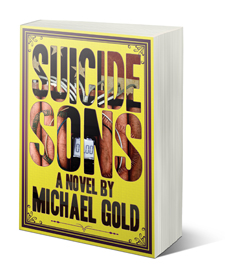
SUICIDE SONS
by Michael Gold
Publisher: Silverthought Press
ISBN: 978-0-9841738-8-4
388 pages
|
SUICIDE SONS
by Michael Gold
“Will it please God that I die?”
“Yes, son. It will please God.”�
Alienated from virtually everything that surrounds him, Akeyde Kletser has to decide if he is willing to commit suicide—and take hundreds of others with him—for the sake of his religion and his tribe. His father urges him on, citing their religion’s holy texts. They worship the Zan religion, founded 6,000 years earlier by a father who killed his son because God asked him to do so.
read excerpt: excerpt 01
Click to purchase your copy from Silverthought Press. |
Mark R. Brand: When was the moment—and there may not have been one, but for me there always is—when you decided that Suicide Sons had graduated from "an idea" to "I need to write this book"?
Michael Gold: This book didn't start with 9/11. But 9/11 changed me. I was working at a public relations firm in Stamford, Connecticut at the time, and living in Manhattan with my fiancee. We were in the middle of a teleconference at work when one of the guys on the phone said that he had heard that a plane had hit the World Trade Center. I figured it was a small private plane and that it was an accident. What kind of plane crash could hurt the Twin Towers? They were made of steel, and huge. They were so big they made their own weather—they attracted clouds. They were really ugly, too, but I had spent a good amount of time near them and in them. I liked them. I went up on the WTC roof deck. I used to go shopping there in the mall in the basement. I often walked by the CNN studio, when it was based there.
As the news came in to us in Stamford, the company shut our office down and I found out I couldn't get back into Manhattan. Manhattan was in lock-down. My fiancee worked on 28th Street. My future father-in-law and sister-in-law worked near World Trade, and they had to run for their lives when the towers fell. My fiancee's office was closed, the subways were closed. A co-worker's wife worked for Chase downtown. She had to be hosed down in case she had been sprayed with biological weapons. There was a lot of fear bubbling around us.
I got laid off from my job in November, 2001, which had nothing to do with 9/11. I became a New York City school teacher. I taught elementary school in Queens. I had several students who were Muslim. My heritage is Jewish. I thought, what if these kids or their parents find out I'm Jewish? Are they going to hate me?
Also, Queens is an amazing mix of different ethnicities. I have had students from Morocco, Bangladesh, Pakistan, India, Mexico, Colombia, Ecuador, Dominican Republic, Honduras, Puerto Rico, Caribbean islands, you name it. So there were all these kids with multiple cultures in my classrooms.
My fears about the Muslim kids soon subsided. Many of the Muslim kids were great students. They are, in many ways, a classic immigrant story. They work hard. Their parents work hard. They are trying to make it in America.
At the same time, I have seen lots of hatred spewed online and in the newspapers about the Jewish people. When the president of Iran calls Israel an "insult" to the world that must be wiped off the map, it makes me angry. I am American through and through. As a kid, I played baseball, basketball, and football in the streets. I inhaled the history of the United States throughout my school years. I still love reading about the Founding Fathers. I have visited Mount Rushmore, for heaven's sake. I love my country—the good old USA.
Yet my national feelings can be turned tribal in a minute when I read what the president of Iran says about destroying a country more than 3,000 miles away from where I live, a little nation I have never visited.
And as I read about all these suicide bombings overseas, I got to thinking—what cultural baggage do we bring to America? What kind of allegiance do new immigrants still have for their home countries? And how does that affect the way they conduct themselves here?
I think the ultimate moment in which I decided to write the book was when my students would talk about where they came from, whether it was Mexico or Pakistan or Bangladesh or Colombia, by calling these places "my country."
Wait a second. This is the United States. This is your country. But they don't necessarily see it that way. They have many family ties to their home countries. And they can fly back there anytime.
MRB: I'm interested to hear how you think Suicide Sons fits into the ongoing larger cultural conversation about terrorism. Which is to say, I realize you've been working on this one for quite some time and this may be something that's changed since its initial conception, but since the World Trade Center attack in 2001 is the one single event that most people readily associate terrorism with this decade, and since the book is set in New York, it's bound to draw some comparisons by readers. At this juncture, eleven years after the September 11th attacks, do you feel that Suicide Sons has more to say about us as we are now, or is it a response that's anchored to that specific time and place and the events that followed?
MG: This book is not a response to 9/11 per se, but the ongoing suicide bombings and religious violence I read about overseas, such as Muslims and Christians in Nigeria killing each other, or some Israeli kids who tried to lynch a Palestinian boy, or a man who shot a little Jewish girl in the head, execution style, in France some months ago. All this death is sickening. And it's motivated by extremist religious beliefs.
The book is also a reflection on people who think that they know what God wants. There are great numbers of people who believe that what's in the Bible is the unquestioned word of God. This thought becomes deadly when people believe God wants them to kill unbelievers. Just a few months ago, someone from the Westboro Baptist Church tweeted about the Sikh Temple killings, "Did God send another shooter?"
Are you freaking kidding me? And yet whomever sent this tweet really seems to believe that God would send a gunman into a Sikh Temple in Wisconsin to kill six people. How can I believe in a God who would try to kill people? Any people, from any religion.
Aside from religious murder, there are people who believe God wants them to do certain things. Before he was elected, George W. Bush once said he thought God wanted him to be President of the United States. Ann Romney was quoted in the New York Times on May 20, 2012, as saying that she and Mitt both "felt it was what God wanted them to do."
A letter in response to this thought was printed in the Times on 5/24. It quoted Susan B. Anthony as saying, "I distrust those people who know so well what God wants them to do because I notice it always coincides with their own desires."
MRB: Were there any books in particular that you took inspiration from in crafting Suicide Sons? Any influential texts that shaped, say, the narrative voice or the plot structure? I had the privilege of reading early versions of this manuscript, and I have to say the final book is comparatively very smooth and readable, and (at least to me) the extent to which you've managed to pull together a handful of fairly distinct narrative styles is impressive. Is this something you had seen done elsewhere and wanted to try, or was it more a case of you having the POVs and character narratives in place and just tweaking it like a puzzle until it all fit together?
MG: This book was a first. When I wrote Horror House Detective, I wrote in a single voice of a guy I knew very well—my father. I knew how he talked, what he thought, how he felt about justice, how he wanted to be a Marine, but let himself get talked out of it by my grandmother and my mom. He also loved bowling, which is a big part of the book.
This book was far more difficult. Because thankfully I didn't have any up close and personal contact with terrorists, I had to imagine what they would think and how they would act. I had to invent two new religions. I didn't want to stereotype anybody. I wanted to isolate the acts of a would-be suicide bomber away from the real-world cultures we know, to see if they made any sense in another context. They didn't.
Also, I wanted to address so many of the tribal and religious conflicts we have seen—from the Turkish genocide of the Armenians in 1915 to the religious tyranny of the Iranian government. I wanted to talk about tribes, and how they fight, why they fight. It's seems like everyday it's West Side Story somewhere in the world—the Jets versus the Sharks.
If anything inspired me in terms of narrative voice, it was the hate texts I have seen in recent years, and the way they can take a human being and reduce them to a caricature. And if you can reduce somebody to that, you can justify killing them.
On Egyptian television a few months back, a prominent national actress said that the Jews killed John the Baptist and other prophets. She said she doesn't like Jews, in a violent, extreme way.
Now, I don't know if the John the Baptist story is actually historically true. Accounts I have read lay the blame on King Herod, a Jewish petty tyrant who was under the thumb of the Roman rulers of the country. So, according to the accounts, one powerful Jewish man had John the Baptist killed. There were approximately 10 million people of the Jewish faith living in the Roman Empire at the time. It seems unfair in the extreme to lay the blame for the Baptist's death on 9,999,999 other Jews living at the time.
Even if it is true that Herod had John the Baptist killed, why should I (or any other Jewish person) be held responsible for something that happened 2,000 years ago? But this woman believes I should be. As far as she's concerned, she's never met me, but in her heart, she knows I'm scum. How comforting that must be for her. I want her to come to America and I want to say to her, "I am not an animal! I am a human being, just like you!"
MRB: The Blue and White temple is one of the book's most vivid settings, as is Razvarr's house. Do these places have real-world corollaries, or are they purely from your imagination?
MG: Razvarr's house, in Corona, Queens, is just a sample of what I used to see when I walked to my job at a school in the area. At least the outside. The houses look flimsy. I imagined the inside as just as flimsy, and suffocating.
The Blue and White Temple was drawn to be a sort of anti-Lincoln Memorial. I love the Lincoln Memorial. I found out its dimensions on the Web. The Blue and White Temple in the story has the same dimensions as the Lincoln Memorial. But where the Lincoln Memorial is a symbol of freedom and justice, the Blue and White Temple is a symbol of the dominance of one group over another. It's also a reflection of the way the Kawidtodian people who worship there think about God—as a very hard and difficult tyrant. Which is very Old Testament, with even more violence mixed in there.
MRB: Time for every writer's least favorite question: Now that you've managed to give birth to this book, and with probably months of exhausting promotional-type activities for Suicide Sons ahead, what's next for you?
MG: After Suicide Sons, I'm hoping to write a book about an environmental superhero who is also a complete idiot.